Travel Agent Leads: Where Good Clients Come From and How to Qualify Them
In short
Key takeaways
A useful lead gives you a sense of the trip, a way to reach the traveller, permission to follow up and an idea of when they hope to travel. Without those details, you may have a name on a list but not enough to start a useful conversation.
What counts as a travel agent lead
It helps to be clear about what counts as a lead. A useful enquiry gives you four things:
- Trip intent. Who is travelling, roughly when, roughly where or what kind of trip, and roughly what it is worth to them.
- A way to reply. An email address or phone number the person expects you to use.
- Consent. They asked to hear from you, or agreed to it clearly. A contact you cannot lawfully follow up is not a lead.
- Timing. When they hope to travel, and how flexible they are on dates.
A newsletter sign-up usually has two of the four. A referral from a past client often has all four before you have spoken. Treat them differently, and count them separately.
Where travel agent leads come from
Most agencies draw on the same handful of sources. They differ less in volume than in how much of the lead you control and how much it costs to keep it coming.
| Source | What you usually get | Who controls it | Watch out for |
|---|---|---|---|
| Repeat clients and referrals | Warm, trusting, often well qualified | You | Slow to scale; depends on asking |
| Your own website | People already looking at you | You | Visitors who leave without contacting you |
| Social media and content | Awareness and occasional enquiries | Mostly the platform | Reach changes without notice |
| Supplier, host or consortium programmes | Shared or allocated consumer enquiries | The programme | Terms, exclusivity and fees vary widely |
| Paid search and social ads | Volume you can switch on and off | You and the ad platform | Cost per lead can exceed lead value |
| Bought lead lists | Contact details at volume | The vendor | Consent, exclusivity and intent are often unclear |
None of these is wrong. The point is the balance. If most of your new clients arrive through a channel someone else controls, your pipeline belongs partly to them.
Before you buy leads or join a lead programme
Paid leads and lead programmes can be worth it, particularly when you are starting out. Ask the same questions of every offer:
- Is the lead exclusive? If the same person was sent to five agents, you are bidding on price before you have said hello.
- How was consent collected? Ask to see the form or page the traveller actually completed.
- What trip detail comes with it? Party, dates, budget and departure point are worth far more than a name and a destination.
- How old is it? Travel intent decays quickly. A lead that is days old is a different thing from one that arrived an hour ago.
- What are you paying for? Per lead, per booking or a share of commission. Work out the cost per booked client, not the cost per lead.
- Who owns the client afterwards? Check whether the client, and their repeat business, stays with you if you leave the programme.
Your website is the lead source you own
Your website gives people a way to find you directly and lets you shape what happens next. But visitors can leave without making contact, and it's easy to miss how often that happens.
Someone may visit, browse a few pages and leave without making contact. If they haven't chosen a destination, a form asking “Where would you like to go?” can be hard to answer.
That visitor may be looking for exactly the help a travel agent can offer. But the form asks them to choose a destination before you offer any guidance.
Small fixes that help
- Ask about the trip, not just the person: who is travelling, when, from where, and what matters to them.
- Ask how much they hope to spend, and whether that budget is per person or for everyone travelling.
- Let people say they're flexible about where to go; don't make them choose before they're ready.
- Show something useful before asking for contact details: ideas, example trips or a sense of what fits.
- Reply quickly with a personal note. A specific answer makes it easier for someone to continue the conversation.
Qualify before the first call
A few details up front can make your first conversation more useful and help you decide whether you can help. Try to find out:
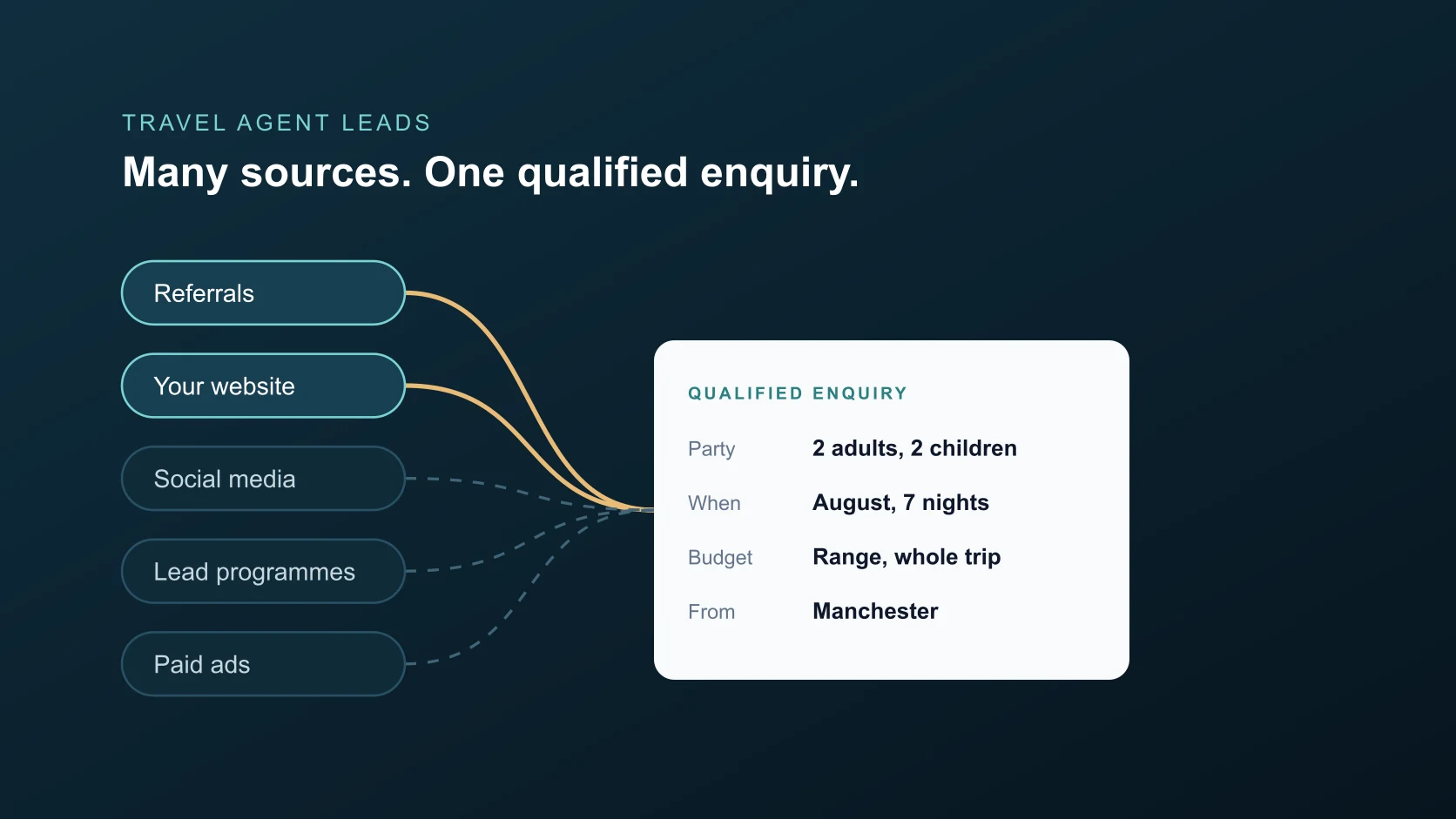
- Party. Adults and children, with ages where it matters. Children change destinations, dates and room types.
- Timing and flexibility. Fixed dates, a window or a month, and how many nights.
- Budget and its scope. A range, and whether it covers flights, stays or the whole trip, per person or in total.
- Departure point. Where they are flying from, and whether a nearby airport would do.
- How open the destination is. A named place, a shortlist, or a description such as warm, quiet and under five hours away.
- What is already arranged. Flights booked, an event they are travelling for, or a stay arranged elsewhere.
If an enquiry already carries most of this, your first reply can be a proposal rather than a questionnaire.
Turning undecided visitors into qualified enquiries
This is where MyEscapePlan's website widgets can help. Visitors describe the trip they're considering and see destinations and dates that fit the settings you've chosen in MyEscapePlan Business. They can do this without creating an account.
On an agency website, visitors can choose an option, check its current prices and send their trip details to you through MyEscapePlan Advisor. The enquiry includes the option they picked and the details they shared. If your platform handles bookings, we can send them there with their choice already filled in.
That gives you the traveller's choice and trip details before you reply, even if they arrived without a destination in mind. The widgets are currently available through a pilot, with each setup tailored to one website and a specific goal.
Measure leads by what they become
A high lead count can make a channel look more effective than it is. Track each step towards a booking for each source:
- Visitors or contacts reached
- Enquiries received
- Enquiries qualified (enough detail to quote)
- Quotes or proposals sent
- Trips booked
For each source, add up the money and time it takes, then compare that cost with the bookings it brings in. A channel that sends half as many leads can still be the better one if twice as many of them book.
A 30-day plan
- Week 1: List where your last twenty booked clients came from. Most agents are surprised by the answer.
- Week 2: Ask every recent happy client for one introduction. Make it easy: one sentence they can forward.
- Week 3: Rework your website enquiry path so an undecided visitor gets something useful before you ask for details.
- Week 4: Start counting the five funnel steps above for each source, and review the numbers monthly before buying more leads.
Start with what you can influence: make it easier for visitors to ask for help, follow up with a personal reply and track which enquiries become bookings.